Showing posts with label herbicides. Show all posts
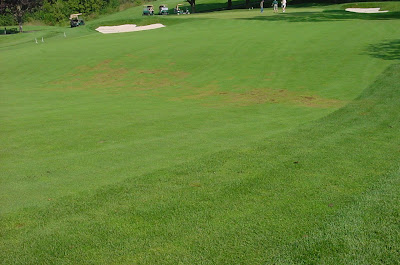
From time to time we are asked by a company if we are willing to test a product in the real conditions of a golf course.  We do not turn down the opportunity to assist a company who is working towards the same goal we are, which is improving turf conditions.  This is the first time we have come across these results.  Only 4 days after the application, I saw this on the driving range fairway.

We test this product in 4 locations around the course and this plot turned out to be the worst.  It is bad enough that the sequential applications that the program called for have be halted.

One reason they have been halted is we have already gotten the results we were looking for after the first application.  This is a product that can be sprayed to kill the annual bluegrass(poa annua).  It did kill the annual bluegrass.  The problem is that it killed the bentgrass also.

You may have been able to see this spot from the driving range tee, behind the Ash tree.  This spot has since been sprayed with green dye to mask the application.  This area will have to be reseeded.  This other areas we sprayed are much smaller.  We have seen some discoloration on those areas, but the turf has not died.
The last update on 2 approach was the information on reseeding the herbicide damage. The seed that was applied, did germinate and begin to grow, but the cool, cloudy temperatures slowed the maturation of the seedlings. It was decided to go ahead and sod the damage to establish a cover before the end of the year. Our decision turned out to be a very good one. With the abnormally cool temperatures, and possible record low temperatures at night, the seed would have stopped growing until next spring.


The repaired area will continued to be played as "ground under repair" for the remainder of the year.
The reseeding on 2 approach was completed today. The ropes will be up for about two weeks to help establishment of the grass. You will notice the area has been marked as "ground under repair" so you may play this area according to Rule 25 (Drop at the nearest point of relief, no closer to the hole).


This past week has brought about a change in the approach on 2, and various other spots on the course.


These spots are the result of a herbicide application to control weeds in these areas. The pattern was created by the hand sprayer used to spot apply the herbicide. We did anticipate some discoloration of the turf, but not to the point it is currently exhibiting. The application was made now in an attempt to establish turf in the areas where the weeds died before the end of the year.


2 approach is the largest, and is exhibiting the most significant damage from the application. This area is the largest area that has been treated on the course. The weed on 2 approach that is being controlled is called Common Knotweed. The weed has died, unfortunately some of the grass has died with it.


The dark brown plants in this picture are the Knotweed plants. You can see the discolored and thinned turf as well.


There is a good amount of green grass still in the discolored areas, but this will take a couple of weeks for those to reestablish. We plan on dropping some seed in these areas early next week to help recover from the injury and establish turf where the weeds were.


The other areas on the course are much smaller spots, and we do expect those to recover from the injury.


12 approach

This year we have been using a plant growth regulator(PGR) for the suppression of annual bluegrass(poa annua) in our fairways. You may have noticed yellow spots in the fairways from time to time this summer.


These yellow spots are annual bluegrass and it's response to the PGR. The product selectively regulates the growth of the annual bluegrass more than the bentgrass, giving the bentgrass a competitive advantage.


Annual bluegrass that is growing slower than the bentgrass


Injured annual bluegrass leaves


An area that has been treated, and is currently noticeable, is in 1 fairway. This is an area of excessive overlap with the sprayer, so the injured area has received double the rate. This overlap, combined with the stress from the current weather patterns has resulted in the damage showing on the bentgrass as well.


This type of program is successful with the suppression of annual bluegrass, it will not eliminate the annual bluegrass. If this program is not continued through the season, the bluegrass will recover from the damage. This approach is a continuous effort that will be sustained from year to year in an effort to slowly reduce the population of annual bluegrass.
Previous PostOlder Posts Home