Showing posts with label greens. Show all posts
The winter weather extremes are still the talk of Chicago area courses (especially with another blanket of snow today!), and likely will be for several more weeks while courses tend to the recovery process.  In this week's CDGA Turf Scouting Report posted yesterday, we learned the NOAA has declared this the coldest winter on record for Chicago.  I do not see anybody lining up to dispute that yet!  Several resources from several organizations have been produced over the past month regarding winter damage and the accompanying recovery process.  This is a result of the widespread winter damage across the upper midwest.  Courses from the east coast to Detroit to Chicago to Milwaukee are experiencing varying levels of winter damage.  Reports of reseeding greens and fairways are not hard to come by.

Here is a short list of recent publications on winter damage:

CDGA Winter Issues letter
Cool-Season Turf Winter Kill Potential
Winter-Weary Golfers need to be Patient
Recovery Will Be Part of the Preparation for the Season
MSU Ice Damage and Winter Kill bulletin
USGA Webcast: Severe Winter Concerns
MI Ice and Recovery Seminar Summary
Winter kill 2014: What to do now

We have not been immune to winter's wrath.  Evidence of the extreme weather is in our fairways.  Most obvious to me is the areas that have been damaged are areas that receive a longer duration of shade through the day.  This results in a weaker plant that will be less tolerant of weather extremes.  These areas also have higher populations of annual bluegrass (poa), which is less tolerant of weather extremes than bentgrass.

This picture clearly shows the the greatest area of damaged turf resides in the portion of the fairway that receives the most shade.  These trees are lining the south side of the fairway.

These areas of the fairways that exhibit the greatest level of damage have been over seeded in an attempt to expedite recovery.  Expect these areas to be roped off for some time until a decent stand of grass can be established.  These areas include spots in 2, 4, 5, 8 and 12 fairway.

The greens and tees on the course have come through the winter very well.  The benefits of the recent renovation are evident in these areas.  The greens and tees have predominately bentgrass which is showing its winter hardiness.  The 7th green is thinner to start the year.  It is no coincidence that this green had the longest duration of ice cover through the winter resulting in stresses, even on the bentgrass.  We will gauge the necessary recover efforts for this green as grass begins to grow.

 The spring will still be progressing slowly.  We will not be ramping up our manicuring efforts until the grass begin growing at a reasonable rate.  Though the grass is certainly greening up, not much is growing yet.  40s for highs and 20s for lows does not help any.  But, it looks like we will be back into the 60s by weeks end!
The primary playing surfaces have been cleaned, bunkers raked, and holes cut.  The greens are back in play on Saturday for the 2014 season.  Though the calendar says April 5th, the weather has not acquiesced.  Early spring conditions prevail on the course.  We have also completed our spring aeration, so greens will be sandy, bumpy and slow for the weekend.  The key phrase is "in play", not necessarily "in shape" yet.  The soil has thawed, the grass has greened and they will safely accept traffic, so get out and satisfy your golf cravings in some sunny weather.

Our greens aeration was originally scheduled for April 7th.  However, with the great weather on Monday and Tuesday this week we moved up the aeration to take advantage of the great weather.  As usual, growing conditions will dictate how rapidly the holes will heal.  With some sun, and warmer soil temperatures, it will not take long.

April 2, 2014

March 27, 2012

It is funny to look at the two weather extremes side-by-side.  2012 was a very mild winter with a very early spring.  2014 is the exact opposite.  Warm weather and time will get us to this point.  Unfortunately, we can't control either one.
It appears that the first frost delay will be happening later this week.  The first frost is much later this year.  We had 5 frost delays in the middle of September last season.  As usual, when frost is on the grass, we can not allow traffic on the course.

We have made several posts for the reasons we avoid traffic during frosts.  Please refer to these for more detailed information:

Frost for Friday?

Frost


The greens have recovered from the scheduled aeration that took place last Tuesday.  8 days after aeration they are back to putting well.  We did not push them back to normal due to the forecasted heat.  The putting green has not been as rapid in its recovery.  The heat and traffic that the putting green has been subject to has delayed its recovery.  When the weather accommodates it, we will be able to fertilize the green and it will recovery shortly.

You will also see some white dots around the edge of the green.  This is the last part of the aeration process.  We will leave the outside pass on the greens for a few days, then use the dots to keep the collar a consistent width on all the greens.  The grass will grow out of the dot in a few days as well.  Refer to this post (Soils and Water: Greens) to review the benefits of aeration.  8 days to recover during high heat is a small cost to the benefits of this practice.
Our greens were constructed with a sand mixture during the renovation project.  From the previous post, this gives us the benefit of large air spaces in the soil.  Those large air spaces allow for water to move through the soil profile very rapidly and space for roots to grow.  Two very important benefits for an area that is subject to such high demands.

The picture on the right is of a profile from one of the greens.  This profile is an example of how we want the profile to look.  Clean consistent soil throughout the full profile.  We can also gather from this that there exists an excellent root mass in the profile.  The root mass is dense enough to keep the sand profile in tact through the depth the core.  You can even see a tiny root sticking out the bottom of the sample.  Our objective is to keep this profile in this condition over the long-term.  This will allow for the consistent, high-quality playing surface the golfers expect.

Towards the top of the sample on the right, it appears to have a darker color.  This is the organic matter that exist in the soil from the constantly growing turf we talked about is the previous post.  This layer is why we intensively manage the surface with verticutting, topdressing and aeration.

This profile better displays the organic matter layer that is in our greens.  This is typical of greens that have been constructed with a sand.  This organic matter has built up since the greens were constructed.  It is not likely that we will ever be able to completely rid the greens of this organic matter, but we are able to manage its development.  From the previous post, I mentioned that organic matter in the soil has the ability to hold a large amount of water.  Aside from the myriad of agronomic issue that would be created if this organic matter build-up was ignored, the playing surface would become soft, spongy and inconsistent.  The problems arise when the consistent flow of water through the profile is inhibited by the amount of organic matter at the surface.  Our goal is to dilute or remove the organic matter through topdressing or verticutting and aeration.  By consistently incorporating these practices into the management of the greens, we can keep the organic matter at a low enough level to maintain the benefits of the sand based soil and a uniform profile.  This will then allow us to provide the firm and smooth conditions of a high quality playing surface.

This post comes a few days after we completed an aeration of the greens.  This picture shows the new sand channels through the organic matter.  We removed a core from the soil, let it dry, then dragged the sand off the core and back into the soil.  The organic matter that we removed does not break up and we are able to blow the debris into piles and remove it from the green.  These sand channels provide for a more consistent movement of water through the profile.

The consistent movement of water through the profile is the reason these practices are done.  The consistent growth of the grass is the reason that they need to been done as often as possible.
We were able to complete the majority of our scheduled greens aeration today.  We have cored and cleaned all greens.  We will need to complete rolling the back nine greens in the morning.  Our electric roller is not able to finish the greens after an aeration due to how soft the greens are immediately following the procedure.  Greens will be soft, bumpy and slow following aeration.  They always are.  But, they always get back to normal after a few days.  Our first priority will be to get the greens smooth again.  Soon after that, the familiar ball roll distance will be back to normal as well.
Our fall aeration gets kicked off next week when we start with the greens on Tuesday September 3rd.  There will be a regular flow of aeration happening through the fall on all surfaces.  Greens will be first; tees, fairways, approaches and roughs will all be done with different methods on a regular interval throughout the fall.  We are mindful of the golf schedule when we schedule these type of practices.  However they are necessary, and long-term benefits certainly outweigh any short-term disruption of the surface.  I intend to have other posts that address aeration and its goals in more detail this week.
I am reposting this video that demonstrates the proper method for repairing ball marks.  Play has been picking up on the course and ball marks are becoming very noticeable.  It is not hard to repair a ball mark and it only takes a few seconds.

Two things are critical to repairing a ball mark correctly:

1. Pull the grass from the edges to the center of the mark. - When a ball mark is made, it is very likely that grass will die in the middle of the mark.  Pulling the grass from the edges to the center leave less area for the grass to cover while healing.

2. Tap the repaired mark level after fixing. - After fixing the mark, always tap any raised grass level.  This leaves a level surface for the next group.


I have some catching up to do with blog post from last week.  Most of this you will have already seen if you were fortunate enough the enjoy the beautiful weather for the Walrus Open on Saturday.  We completed the first aeration of the year on the greens last Monday.  A verti-cutting, aeration and a little topdressing was completed all in one day.  We had some disruptions in the plan for the day, but everything was completed.

This is the first spring aeration that has been done on these greens.  Our biennial Turf Advisory Service visits with the USGA agronomist have recommended adding a spring aeration to stall the accumulation of organic matter created by the dense growing habit of the grass.  This is a process we will try to do as many times as possible, however, playing conditions remain a top priority.
There are examples on several greens throughout the course of damage from traffic over a frozen green.  This is why we play to a location in the approach rather than allow traffic on frozen greens.  There are many days during the winter when the weather is sunny and warm, but the soil and the portion of the turf canopy closest to the soil is still frozen.  The growing point of the grass plant is in this area of the canopy just above the soil surface.  Exposure to any type of compression while frozen with damage that portion of the plant.  The brown leaf blades on the greens in the shape of a dog's paw(or coyote) show what the damage looks like.  This is the same damage that would occur if traffic is allowed on frost covered grass.

Most of the spots on the greens are from a paw prints.  However, 10 green has some significant damage from foot prints.  Perhaps somebody was playing to the greens in the winter when they should not have been?  I do not know.

These areas should grow out, but it will take time.
The greens will be open for play tomorrow, Saturday, March 30th, after any possible frost delay.  The course will still be in its winter condition.  The bunkers will not be raked and will not have rakes in them.  Also, no course accessories will be on the course, no halfway house and no carts will be available.  With the forecasted temperatures, it still looks like it will be a few weeks before we will be able to do any maintenance on a regular schedule.

It seems like a long time coming, but on average, we are right on track.  Here is a chart of the opening dates since 1989 (2007 is not included due to the renovation project).  There is certainly no pattern or trend, but the average opening date is March 26th.

It is still amazing to look back and see the contrast to last year.  This picture is from March 29th last year.  All the grass was green and blooms were on the trees.

See you on the greens Saturday!
We made lots of progress today towards finishing our on-course preparations for winter.  The greens are closed for the season and the temporary targets are in place in the approach.  Please do not walk on the greens until next season.  Tee markers, benches, ball washers, trash cans, signs and ropes are all off of the course also.  The Halfway House is closed for the season and cart use is finished for the season.  It has been a long year and the course is looking forward to some rest.  The irrigation system will be winterized starting tomorrow and our winter snow mold treatment will be going out later this week also.
This past weekend was the last weekend for the greens this season.  We put the temporary cups in play today, and ask that you avoid traffic on the greens until the spring.  During the cold weather, we do not want to subject the turf to any stress that it will not be able to recover from while dormant.  Also, traffic on frozen or partially frozen greens can cause significant tissue and/or root damage.

Here is a link to a good article from the USGA Green Section about traffic on frost or frozen ground: Playing Par With Jack Frost

We are also applying a layer of topdressing to the closed greens today.  This topdressing will be slightly heavier that the regular topdressing we apply through the golfing season.  The purpose of this topdressing is to act as a blanket for the greens through the winter.  The sand will provide a layer of protection from the wind when the greens are not covered with snow.
The rain held off just long enough for us to complete the areas that we wanted to have done before the rain came.  The greens have been aerated, topdressed (will be topdressed again soon to completely fill the holes), and fertilized.  The tees have been aerated, verticut, topdressed and fertilized.  The approaches have been aerated, but we have not topdressed them yet.  That will likely be done next week.

We did not make any progress on the fairways yesterday.  The machine broke down, and will be a few days before the parts arrive to fix it.  However, we will be continuing the fairways with our other aerators today.  Our verticutter for the tees also broke down yesterday. (getting towed back to the shop on left)  Fortunately, only two sets of tees did not get done.  Fairways 11 and 14-18 have not been aerated yet.  We will be working on them this week, but won't complete them until early next week.

The rain that we received overnight did a good job of working in the sand on the greens.  It will take a few days of growth to get the sand worked in better and start the road back to smoother greens.  Until then (probably sometime next week), the greens will be slow and bumpy.
We were able to finish the greens aeration yesterday, and the tees have been aerated and cleaned.  We are waiting for the material that we will use to topdress the tees.  We did start on approaches last night, and were able to complete 10 and 17.

We will be topdressing the greens again soon to ensure all holes have been properly filled.  The greens will be bumpy and slow through the week as we work to get them smooth again.

We are continuing the fairway aeration today.  9 of the 14 fairways are completed.  We are also aerating approaches in play the rest of the week.  Please watch out for the workers.
Allowing air below the soil to exchange with air above the soil is a regular maintenance practice for us throughout the year.  We have many different pieces of equipment that we can use depending on what our ultimate goal is.  Through the summer we try to get through the course every 3-4 weeks, but use equipment that will cause minimal disruption.  We decided this week would be a good time after the very hot temperatures and the excessive amount of rain we received over the weekend.

On the greens and tees we used a "needle tine" on our aerators to create a small hole about 6 inches deep.

Conny spiking our tees today.

Here Torres is using our aerator to spike 4 green on Monday.

Torres is using a different piece of equipment to spike our fairways today.  It take one person about 10 hours to get through all of our fairways and approaches with this.

This is a nice piece of equipment to use in the summer.  It is quick, and leaves very discrete holes that are 2 inches deep.

The greens are done and the tees, fairways and approaches will be done by the end of today.  We hope that this will allow the soil to dry quicker and more evenly after being saturated for a few days, but more rain in the forecast over the next few days.  If it does rain, these holes will allow the rain the infiltrate the soil quicker.
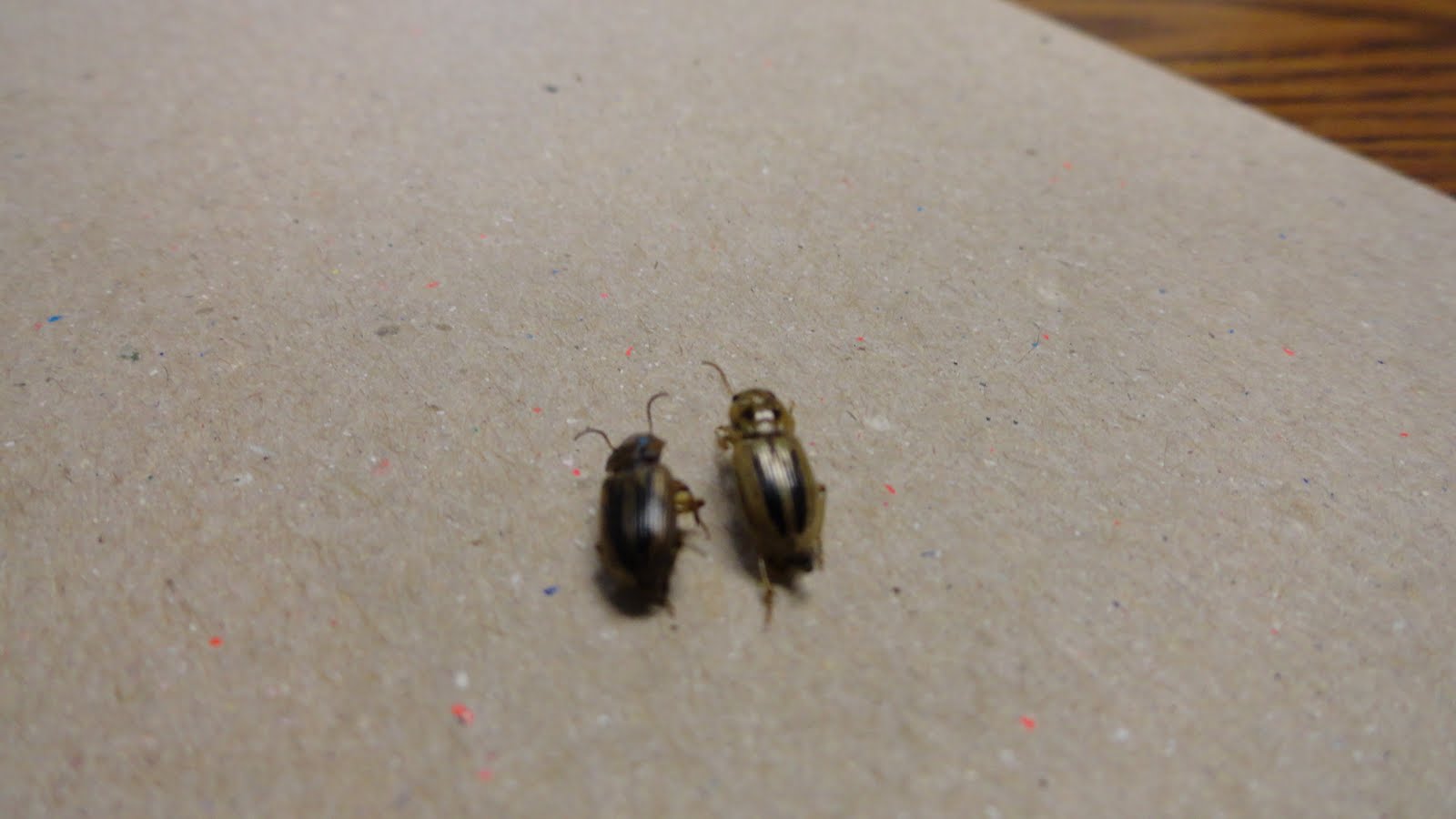
Throughout the past week a beetle has been burrowing in the putting green and creating several little mounds.  These beetles have not been causing any damage to the green, but the mounds are difficult to putt over.

The beetle is the seedcorn beetle.  Other than creating the mounds, we do not foresee any other issues.
The club has played host to several events over the last 5 days.  We were fortunate that the thunderstorms late last week did not prevent any of the events from being postponed, however the rains that came with them have left evidence of the soggy soils they created.  Carts were allowed on the course to better accommodate the large amount of play and a few areas have been damaged from the cart traffic.  These areas have been roped off, and now that the soil has dried, were not as bad as we had originally thought.  We thought some sod work was going to be necessary, but we will now apply supplemental fertilizer to these areas to aid with recovery.

Monday the course played host to an annual outing that is perennially the busiest day of the year.  This has resulted in the divots and ballmarks that come with normal play.  Another member event yesterday, along with member play has added to the divots and ballmarks.  Check the June Divot Digest for more information on ball marks and ball mark repair from yesterday's post.

Nothing lasting will come of these events, however the short-term will show evidence of the heavier than normal play.
The greens have been very slow this week.  We are working to fix this as soon as we can, but it will likely take a few days to fix this issue.  Our mechanic, Greg, has been away from the course on an unexpected temporary medical leave since Friday, May 6th.  Thankfully, Greg has been able to return home, and is expected to be back to work next week.  As you have noticed this week, Greg is extremely important to our quality of cut and it's impact on green speed and smoothness.  We have done our best to continuously adjust the mowers, but we are off our sharpening schedule.

The warm weather this week has been excellent for golf, but is also working against us in this area.  The warm nights allows the grass to grow more through the night which results in more leaf tissue on the surface.  When the mowers are not as sharp as they should be, that means more leaves are being left behind resulting in slower greens.
If all the world's golf course putting greens had the ability to express the magnitude of their tortured existence - in a manner that could be recorded by the print and broadcast media, there would surely be a new Guinness Book of World Records mark for "Volume of Complaints from a Single Source."  I have chosen to speak for the greens.
Wouldn't you scream to high heaven if thousands of rock-hard golf balls speed from the sky each week - tearing into your outer skin, crushing your tender circulatory system, traumatizing your nervous system and leaving unsightly depressions that require about five days to heal if repaired immediately, or two weeks if unattended to?
Wouldn't you raise particular Cain if part of your daily regimen was to submit to being trampled and disfigured by ever-increasing hordes of thoughtless players - each of whose shoe-bottoms contain 24 half-inch metal spikes that are designed to prevent slipping on tees, fairways and roughs - but are not meant to be part of an adagio dance on a green's tender surface (or leap in the air and click of of the heels) after holing a 50-foot "no-brainer" putt?
The foregoing barely scratches the surface of the number of ghastly horrors that daily attend the overseeing of current state-of-the-art greens.  Construction costs for greens today approximate $100,000 to $250,000.  With the 18 greens, superintendents find that they are dealing with 18 different personalities.  Let's look at some background:
In golf's earliest years (1450-1850),  putting surfaces were not clearly defined.  They were the immediate, semi-barren areas surrounding a gull feather that protruded from a partially filled in rabbit hole.  The driving area for the next hole was only seven to 10 paces away from the gull feather.  Wet sand for teeing the ball on the succeeding hole was obtained by reaching onto the hole just completed and grabbing a handful!
Golf, in its totality, was quite a simple game for its first 450 years, when less than 150 courses existed worldwide.  In Scotland, it appeared that nature created links-land to accommodate the game.
In the last 100 years, the game's popularity, capitalistic opportunity and mega-marketing have caused serious crowding and cost crises.
Threats to perishable putting surfaces today are truly legion.  They include: frost, ice, hail, snow, humidity, birds, insects, rodents, sun-baking, loose farm animals and "Bambi," rowdy teenagers, floods, worms, beetles, fungi, snow-mold, competing grasses, irate and thoughtless players and poor maintenance equipment.
Walking on frost-covered greens crushes the blades (not the roots) which thaw to an off-white color in the shape of the foot that crushed them.
Large flocks of geese nibble at the slightly taller grasses at the green's fringes.  They can tear out fids of turf the size of a wedge divot.  Swarms of starlings deface greens by pecking open 1-by-2-inch holes in search of cutworms.
Adventurous teenagers can be severely destructive.  Driving across greens while violently spinning the wheels is a criminal act.  Using the flagstick or broken branches to scrawl obscenities deep into a green's surface means heavy fines and extended community service.
Player indiscretions include such things as carelessly replacing the flagstick so that it breaks down the sharp edges of the hole, which can cause putts to lip-out for players that follow.  If you have a relatively short second putt and will have to wait to finish, mark your ball and move a good distance away from the hole.  If all four players are standing whispering distance from each other when the last party putts out, it means that all four players will then turn at the same time to head for the next tee.  What happens at that moment is that four pairs of shoes (with some 96 spikes) will turn and "push off" from the very crucial putting area around the hole.  A forest of nearly 100 small soil eruptions (called spike marks) appear and they become like roadblocks to players that follow.
Words may be exchanged; there are still a few dim bulbs who insist on repairing their ball marks by tapping in the sides of the depression with the toe of the putter and sickening eyesores can occur and linger when an irate player (after missing and 18-incher) takes a swipe at his ball with the putter - misses - but lifts out a fairway-sized divot from the pristine green.  The awful scar telegraphs the guilty party's name to every member of the club.  The memory of the act is as a hard to remove as a tattoo.
A suggestion to parents: Should a son or daughter make so much as a peep about desiring to become a golf greens superintendent, seek psychiatric help for the child immediately.  That is unless he or she was born with cartilaginous scales for skin, a prehensile tail and breathes fire from both nostrils.

Herb Matter, Jr. - The Naperville Sun, Friday, July 22, 1994


Herb Matter, Jr. was a long-time member of Naperville Country Club, and a member of the Matter family who is referred to as "The First Family" of Naperville Country Club.  Herb Matter, Sr. was a founding member of the club in 1921.  Herb Matter, Jr. was an avid golf historian and collector as well as a columnist for The Naperville Sun for 15 years.  This is one of his columns from his time at The Naperville Sun.  A full collection of his columns are compiled in a book that is available at the club.  With golf season upon us (eventually), I felt like this would be a good reminder for the golfer to do your part to preserve the playability of the greens through the season.

The Anatomy of a Pitch Mark - USGA Green Section

It's Not the Tool - It's the Toolee - USGA  Green Section

An Appeal for the Return of Golf Course Etiquette - USGA Green Section
Previous PostOlder Posts Home