Showing posts with label topdressing. Show all posts
We began our fairway aeration process on Monday.  Two fairways were completed Monday and we are attempting 2 more fairways today.  This is a process that will span the period of a few weeks.  We will be completing this practice around golf and weather, so players should expect to see us as they play.

There are several parts of this process which will result in the work lasting a few weeks.  We are topdressing the fairways heavy with sand.  We are then using one aerator with a solid tine to create a large deep hole then following that with another aerator that is pulling a small core.  We then drag all of that together and clean up whatever is left.

This will cause a large amount of disruption to the playing surface and a period of time will be needed for the fairways to heal.  With the frosts that are now predicted, healing time will be delayed due to the slower growth of the grass.
We are wrapping up the first topdressing and aeration on the fairways this season.  Like so many other things, the rain last week delayed us on this project.  Once the water was off the course, we then had to wait for the soil to dry enough to get heavy equipment back out.  We will be done by the end of this week.

We use a large solid tine in the fairways to break up the soil under the surface.  We are not pulling a core in the fairways and approaches to allow for quicker healing.  This is a project that we can do over a few days time if weather cooperates.  Lets hope the next round will be a little drier.
This past weekend was the last weekend for the greens this season.  We put the temporary cups in play today, and ask that you avoid traffic on the greens until the spring.  During the cold weather, we do not want to subject the turf to any stress that it will not be able to recover from while dormant.  Also, traffic on frozen or partially frozen greens can cause significant tissue and/or root damage.

Here is a link to a good article from the USGA Green Section about traffic on frost or frozen ground: Playing Par With Jack Frost

We are also applying a layer of topdressing to the closed greens today.  This topdressing will be slightly heavier that the regular topdressing we apply through the golfing season.  The purpose of this topdressing is to act as a blanket for the greens through the winter.  The sand will provide a layer of protection from the wind when the greens are not covered with snow.
Our fall projects are underway this year.  The main concentration this year is a continuation of our drainage list, along with our soil cultivation and fertilizer applications.  The majority of our soil cultivation has been completed.  Greens, Tees, Approaches and Fairways have all been aerated and topdressed.  We are going back through our fairways with a verti-quake now.  This is the machine that slices the soil and leaves the lines.

Here we are adding small drain lines around the catch basins in 8 fairway.  The areas around the catch basins always stay wet after rains for obvious reasons.  These lines will help move more of the moisture off of the surface and into the drains after rain.  We plan to complete the basins in 8 fairway, 12 fairway and 5 fairway by the end of the season.

Yesterday we verticut and topdressed the approaches to finish the aeration process on them.

This will be the first of a series of posts through the summer that will highlight the tools we use to monitor course conditions on a daily basis.  The first tool we will highlight is a Soil Profile Sampler.  We use this on a daily basis to see what is happening to the part of the turfgrass system that we cannot see from above ground.

Just like a hollow tine will pull a core when aerating, this tool pulls a profile of the soil that is about 4"x10".

From this profile we can monitor soil properties, rooting depth, moisture and organic matter accumulation.

This profile is from the fairway.  You can easily see the progress of our fairway topdressing program in this profile.

The profile fits easily back into the soil to prevent any lasting disruption to the surface.
I want to post a short update on the completed greens aeration and show what we are attempting to accomplish with this practice.  The picture on the left shows the aeration holes in the soil profile.  The cores we pulled removed the organic matter, the dark layer near the surface, and sand was used to fill those holes.  As aeration is continually used, more of the organic matter will be removed which will allow for more rapid water infiltration and air exchange.

You can click on this picture for a larger closeup of the green profile.  The greens are heeling well.  It has just now been two weeks since we have aerated (these pictures we taken 10 days after aeration), and the greens have also been exposed to 5 frosts since it has been done.  By postponing this practice until later in the season, slower recovery because of low temperatures can be an issue.  The most recent USGA Green Section Record refers to an article discussing this topic: Understanding the Risks of Coring at Non-traditional Times.  Despite the cooler temperatures, we believe the green are healing well.

We worked at the putting green through most of the day today.  The work involved aerating the green with solid tines, topdressing the green with sand to fill the holes, then overseeding the entire green.

The holes allow for better air exchange between the soil profile and the air outside the green.  Along with air exchange, once these holes are filled with sand, they provide a seed bed for the new seed that was applied.

We applied the sand at a heavier rate than a normal topdressing.  We used the same machine that we use for our normal scheduled topdressing, but the spreader on the back was different.  This spreader drops the sand straight down out of the back of the spreader rather that spreading the sand with a spinner attachment.  Once the putting green was topdressed, the spreader attachment was put back on the topdresser, and our normal scheduled topdressing was completed on the course.

After the topdressing was applied, the sand was worked into the green with push brooms.  Then a light drag mat was used to level off any inconsistencies in the sand.  After the drag mat was finished, seed was applied.

The final act of the day involved fertilizing, then watering.  We used an organic fertilizer on the green, so an odor may be present near the putting green for the next few days.

The putting green will remain closed while the recovery continues.

If you have visited the club since last week you undoubtedly noticed the condition of the putting green.  The damage on the putting green is the result of a verticutting and topdressing done last Monday.  The putting green is notoriously the weakest green on the course due to the amount of traffic that it receives.  The topdressing applied last Monday was the first time it had been topdressed in over 4 weeks because of the hot temperatures that we were receiving.  We decided to topdress last week because of the cool temperatures that were forecasted, however the green was not strong enough yet to withstand the stress.

We have decided to close the green until further notice to allow the green to heal.  The chipping green will be available to putt on while the putting green is closed.

The signs of summer are beginning to show at the Green Department this week.  About 2/3's of the crew started back today, and the balance of the crew will be back next Monday.  As usual on Mondays, we took advantage of the closed day to get some major jobs done.  We spiked and topdressed the greens, mowed the tees for the first time, removed the awning from the front of the clubhouse, began preparing the flower beds for the spring flower (which should be coming this week) and refilled the irrigation system.


Torres ran the aerator with needle tines across the greens today in an effort to help the soil dry and exchange some air after being saturated for so long.  Following Torres we topdressed and dragged the sand in with a brush.


The tees were mowed for the first time today and removing the old growth revealed lots of green grass underneath.  With the forecasted temperatures this week, look for the course to be much greener by next week.


Recharging the irrigation system was completed today with minimal problems.  Look for a post later in the week that will talk more about this.  We do not anticipate needing water soon, but it is ready to go when we need it.
I feel like I am typing the same thing every week, but I'll do it again. It was a wet week and the course remains very wet. We were able to get a few big projects done despite the uncomfortable conditions. Monday we were able to topdress greens and fairways, and begin to remove the dead summer flowers.

The recently betrothed Emilio topdressing greens. Emilio and the lucky lady plan to be married sometime next year.

Torres brushing in the topdressing on the greens.

Cesar applying the fairway topdressing. We will do one more application of fairway topdressing this year.

There have been a set of trees identified on the course as being key trees to the playability and aesthetics of the golf course. Extra measures have been implemented to protect their well-being. A company was out this week to install lightening protection to some of these tree.

Lightening protection being installed to a tree on the left side of 13 fairway.

On Friday we began some of the fall aeration we will be doing. It was decided to aerate the junior tees due to the more apparent thatch layer. These tees are soil tees and hold water for longer periods of time resulting in an environment more conducive to thatch production.

One of the junior tees after being aerated.

The back practice tee and middle practice tee were also aerated on Friday.

Thanks Greg!

We also replaced a few of the retired summer flowers with some flowers for the fall and into early winter.

This is the second post dealing with topdressing practices on the golf course. In this post I will explain our procedures and goals of our fairway topdressing program. As I stated in the earlier post, topdressing is the practice of spreading a light layer of sand over the turf. On the fairways we do this with a large material handler that has a set of spinners on the back that throw the sand as the sand is dropped onto them.

Ramon topdressing the fairways.

Refilling the topdresser.

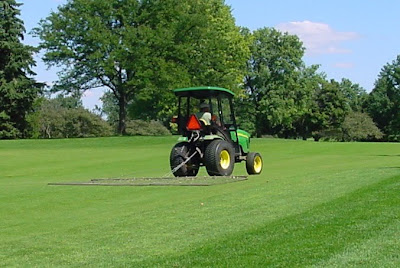
After the sand is spread onto the fairways, the thin layer is dragged into the profile.

Thin layer of sand on the turf canopy.

Antonio dragging the sand into the turf.

Our goals for topdressing fairways are different from the greens. On the greens, our main 2 goals are for smoothing out imperfections on the surface, and aiding with decomposition of organic matter. On the fairways, aiding decomposition of organic matter is a benefit from topdressing, but, our main goal is to modify the soil profile. The soil in our fairways has a high amount of clay. This clay holds a tremendous amount of water, for extended periods of time, thus, delaying the drying time after a rain event. Incorporating a layer of sand on the top of this clay will provide a layer for moisture to dry more rapidly.

You can see sand at the top of the fairway profile.

This is a practice that has been implemented for an extended period of time. As the fairways are topdressed from year to year, the benefits will become more and more noticeable. The most notable benefits to playability will be firmer fairways and quicker drying time after rain events.
This will be the first part of two posts dealing with topdressing on the golf course. I will highlight the greens topdressing practices in this post, and follow up with information on our fairway topdressing practices. Though the application process is similar for each, our goals are slightly different for both areas.
Topdressing is the process of applying a light layer of sand over the surface of the turf. The sand we use for this is similar to the material that was used to construct the green, and is stored in the green tank that is visible from the 10th tee. The tank is utilized to keep the sand dry which makes the sand easier to spread. After the sand is spread, we then proceed to brush the sand into the green.

There are several reasons for topdressing, our two main reasons:

Smooth the putting surface - As the putting surface is used, it begins to show signs of slight wear from many different sources, including spike marks and ball marks. This slight wear begins to create imperfections on the surface of the green. Applying a light layer of sand to the greens on a regular basis levels and smoothes these areas.

Assists with organic matter decomposition - Turfgrass forms a layer of organic material just between the grass blades and the soil. This organic matter layer is called thatch. Management of this layer is important for maintaining a surface for putting. Topdressing helps with the management of this layer. As the sand is continuously applied, it is worked into this layer and aids in the decomposition of thatch and allows the surface to remain firm.

These two benefits are the goals of the topdressing program on our greens. There are other reasons for topdressing programs, one is to modify the soil structure. Modifying the soil structure is not one of our goals on the greens due to the new construction. However, modifying the soil structure is one of our goals for the fairway topdressing program. Check back for more information on our fairway topdressing program coming soon!
Previous PostOlder Posts Home