Showing posts with label tees. Show all posts
Changes around 1 tee have been underway since last fall.  Several projects have been done to provide a fresh look to this area.  We are nearing the finishing stages and hope to have it wrapped up before the Fireworks Extravaganza on June 29th.

The project began last fall when 3 spruce trees were removed to highlight a maturing Bur Oak.  Clearing of the overgrown shrubs behind the tee continued last week.  The remaining shrubs that still stand behind the tee will be replaced with this project.  We have a few steps to complete before we can remove those plantings and introduce new.

The curb was cut today to accommodate the new routing of the path, which will be out of the circle drive rather than around the back of the tee.  The former cart path behind the tee will be cut narrower and used as a walking path.  The additional area from narrowing the path will be used for the new plantings.

Work is also being done today to trim up the pines left of 1 tee.  This work also involves defining grassing lines and spreading fresh pine needles under the trees.
Big changes will continue to be happening around the 1st tee in the coming weeks.  Last fall three spruce trees were removed to highlight a maturing Bur Oak.  This spring the aging and overgrown junipers and arborvitae behind the tee will be removed to make way for new plantings.

The plantings behind 1 tee have become overgrown and unsightly.  The objective of this project is to maintain the screening between the tee and the circle drive, but improve the aesthetic of the area due to it proximity to the front of the clubhouse.

When this project is complete, the cart path will no longer run behind the tee.  The curb will be cut to allow access to the 1st tee from the circle drive.  A walkway will be maintained where the cart path currently is, and the planting bed will be made larger to accommodate new plantings.  The new plantings will be similar to other that are in front of the clubhouse.  These models give an idea of what the new planting may look like when the project is complete.

This project will begin as the cart path on 9 is finishing up.  This will be a great change for the look at the front of the clubhouse.
Our big project this fall involves removing bentgrass from the bluegrass adjacent to the tee boxes.  Large areas on 3 and 4 tees have already been completed.  The other tees are in the process of being cut and cleaned now.  New sod will be arriving next week to complete the project.

The bentgrass variety that is used on the tees has an aggressive growth habit.  This is great for recovering from divots, but does cause problems at the edges. This bentgrass will invade the adjacent bluegrass and become unsightly and at time a maintenance issue.

While we are cutting the sod we are straightening tee lines and making sure the tee boxes stay square.  This will give a much cleaner look to the tees next year.
One of the major sod projects we are working on this fall involves removing bentgrass from the bluegrass roughs on green and tee banks.  Bentgrass from the greens and tees has made its way to the roughs and is unsightly when mowed at the height of the roughs.  There are many ways that this can happen, but the easiest way to fix it is with new sod.  The tee bank on 3 tee (left) was nearly all bentgrass.  The entire bank was stripped and new sod installed.

Roughs immediately adjacent to the tee boxes are the most prominent areas of bentrgrass invasion.  These areas will be done throughout the course this fall. When doing this, the tee box is measured and squared if it needs to be, and the edges straightened.


The tee bank on 4 tee had bentgrass on it, but it was also the victim of the bluegrass billbug larvae, and grubs.

Many of the tee edges will be done this fall, but these are the 2 largest areas of sod to be laid.
We have started our biggest project of the fall this week in 11 fairway.  This is a much needed drainage project on the first half of the fairway.  We will be installing about 5000 feet of drainage tile to allow this fairway to drain more rapidly.  To help us keep the project moving, 11 will be played as a par 3 from a temporary tee in the fairway until this project is completed.  Our plan is to be done by next Friday, Nov. 11th.  Our suspicion is this inconvenience will be forgotten about next year by the noticeable better drainage characteristics of the fairway.  I will be making a post about this project tomorrow.
The rain held off just long enough for us to complete the areas that we wanted to have done before the rain came.  The greens have been aerated, topdressed (will be topdressed again soon to completely fill the holes), and fertilized.  The tees have been aerated, verticut, topdressed and fertilized.  The approaches have been aerated, but we have not topdressed them yet.  That will likely be done next week.

We did not make any progress on the fairways yesterday.  The machine broke down, and will be a few days before the parts arrive to fix it.  However, we will be continuing the fairways with our other aerators today.  Our verticutter for the tees also broke down yesterday. (getting towed back to the shop on left)  Fortunately, only two sets of tees did not get done.  Fairways 11 and 14-18 have not been aerated yet.  We will be working on them this week, but won't complete them until early next week.

The rain that we received overnight did a good job of working in the sand on the greens.  It will take a few days of growth to get the sand worked in better and start the road back to smoother greens.  Until then (probably sometime next week), the greens will be slow and bumpy.
We were able to finish the greens aeration yesterday, and the tees have been aerated and cleaned.  We are waiting for the material that we will use to topdress the tees.  We did start on approaches last night, and were able to complete 10 and 17.

We will be topdressing the greens again soon to ensure all holes have been properly filled.  The greens will be bumpy and slow through the week as we work to get them smooth again.

We are continuing the fairway aeration today.  9 of the 14 fairways are completed.  We are also aerating approaches in play the rest of the week.  Please watch out for the workers.
This is a quick post to supplement the Divot Repair post from a month ago.  Erwin McKone is the Director of Golf Operations at Briar Ridge Country Club in Schereville, IN and has a YouTube channel, and World of Turf blog that I follow.  He has posted a good video regarding filling divots that I wanted to share.


Note: We do not have the divot bottles on our carts, and request that divots in the fairways be replaced when possible.  The Green Department will take care of any further repair.
The following article recently appeared in the USGA Green Section Record. It was written by Ty McClellan. Ty is our USGA regional agronomist. We utilize his expertise on a regular basis; he visits Naperville CC regularly to evaluate course conditions. This is part of a program offered through the USGA Turfgrass Advisory Service. The article is very timely so I wanted to pass it along.


By Ty McClellan, agronomist, Mid-Continent Region
July 13, 2011


Randomly scattered divots (on the left) remove up to 50% more turf than practicing in a linear pattern (on the right) where each new shot is placed directly behind the previous divot. 


Late July is usually the time when there is a lack of turf coverage on practice range tees established with cool-season turfgrasses, such as creeping bentgrass or Kentucky bluegrass.  Heavy play removes divots faster than the turf can recover, and hot, dry summer conditions leave little opportunity for seedling establishment or regenerative growth of surrounding turf.  Poor turf coverage that comes in mid-summer generally indicates that the practice tee is simply undersized for the amount of play received, i.e. there is not enough time for turf to recover before tee stalls are returned to previous locations.  It also indicates that tee stall rotations need to be reviewed for efficiency and that synthetic turf options should be considered at the rear of the tee to provide the additional time needed for turf recovery.
With the exception of an efficient tee stall rotation, enlarging the tee(s) and adding synthetic turf are improvements typically left for the off-season when time and funds become available.  So, until then, what can be done?  The solution resides with golfers.  Since randomly scattering divots can quickly destroy a practice range tee, the better approach is to shrink one’s divots by removing them in a pattern just like the professionals.  More specifically, this includes placing each shot directly behind the previous divot.  This can easily be repeated for up to 10 shots resulting in much less turf being removed.
Let’s take a look at a practical example that was provided by Golf Course Superintendent Chris Pekarek at The Village Links of Glen Ellyn in Illinois.  Mr. Pekarek estimates more than 2 million shots are taken annually from the 1.25-acre Kentucky bluegrass practice tee and that 1.5 million of the shots result in turf removal.  Although divots come in all sizes, the average iron shot is believed to remove a divot 3 inches wide by 6.5 inches long for a total of 19.5 square inches.  After just 30 shots, or a small bucket of balls, 4.1 square feet of turf are removed, given a typical practice routine (30 shots x 19.5 in2 = 585 in2 / 144 in2 = 4.1 ft2).  Therefore, after an entire season, 205,000 square feet of divots are removed from the tee. That's more than 4.6 acres of turf from their 1.25-acre surface.   
If instead each shot is played directly behind the previous divot, subsequent divots are reduced to an average size of 3 inches wide by 3 inches long, or 9 square inches.  After 30 shots, this pattern removes only 2.1 square feet of turf. (As the first divot removes 19.5 square inches and the subsequent 9 divots remove 9 square inches each for a total of 81 square inches, a total of 100.5 square inches is removed for every 10 shots, which is typical for this linear pattern.  For 30 shots or a small bucket of balls, 3 x 100.5 = 301.5 in2 / 144 in2 = 2.1ft2 are removed.)  If everyone adopted this method, the annual number of divots removed would be reduced from 205,000 square feet to just 105,000 square feet.  That’s nearly a 50% reduction in the amount of turf removed.
Implementing this simple divot pattern into your practice regime has significant season-long implications at your facility.  So, rather than voice a complaint about the turf during oppressive conditions in July and August, do the turf a favor and practice like a pro!
Allowing air below the soil to exchange with air above the soil is a regular maintenance practice for us throughout the year.  We have many different pieces of equipment that we can use depending on what our ultimate goal is.  Through the summer we try to get through the course every 3-4 weeks, but use equipment that will cause minimal disruption.  We decided this week would be a good time after the very hot temperatures and the excessive amount of rain we received over the weekend.

On the greens and tees we used a "needle tine" on our aerators to create a small hole about 6 inches deep.

Conny spiking our tees today.

Here Torres is using our aerator to spike 4 green on Monday.

Torres is using a different piece of equipment to spike our fairways today.  It take one person about 10 hours to get through all of our fairways and approaches with this.

This is a nice piece of equipment to use in the summer.  It is quick, and leaves very discrete holes that are 2 inches deep.

The greens are done and the tees, fairways and approaches will be done by the end of today.  We hope that this will allow the soil to dry quicker and more evenly after being saturated for a few days, but more rain in the forecast over the next few days.  If it does rain, these holes will allow the rain the infiltrate the soil quicker.
We have been accomplishing much of the preparations needed to get the course in playing condition.  The greens will be open for play on Thursday this week.  We mowed the greens today and will cut the cups on the greens first thing tomorrow.  There is still lots to do, but some things are beginning to take shape.

 The first time cleaning the bunkers is always a time consuming.  The process involves raking the grass face, then picking up all debris from the face of the bunker and out of the bunker itself.  Then we check the sand depth and move sand around if it is necessary to provide a consistent depth.  We use metal rakes to loosen the sand after settling through the winter.  This process will take more than one day to finish.

The irrigation system was charged today.  We do not foresee needing it for a few weeks, but it is nice to get it going and make any repairs that are usually need to start the year.  This will be a good opportunity to continue our irrigation auditing that we started last year.  More on that in a later post.

A few of the tees were mowed today.  The rest will be done tomorrow.  We also plan to mow the fairways and approaches tomorrow as well.

We do not have a date set yet to open the driving range.  We do want the temperatures to be warmer to allow for better divot recovery.
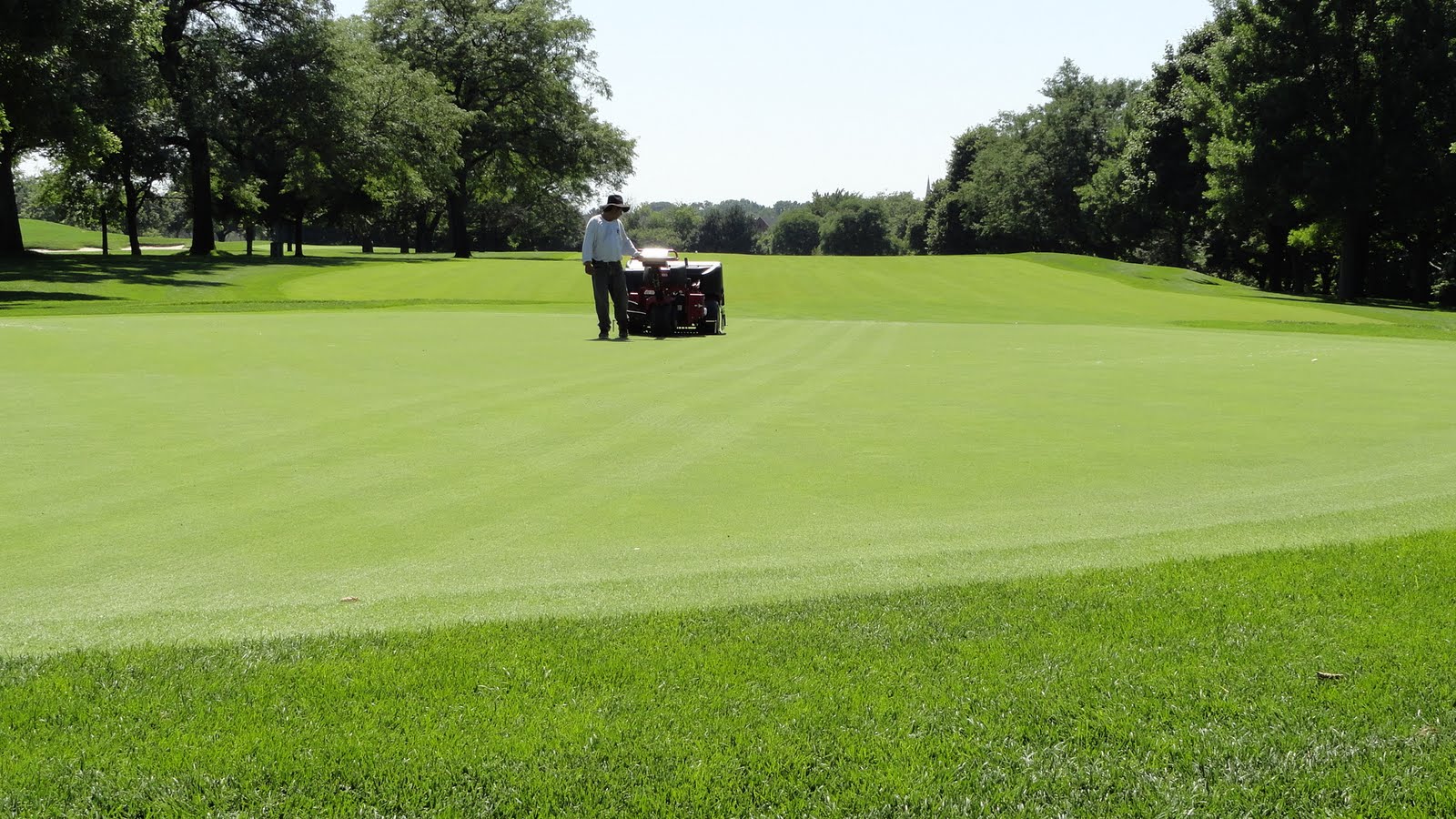
Tee aeration has been started.  A little more that half of the tees have been done through the day on Thursday.  The work on the tees will continue on Friday in hopes to finish before the weekend.

The signs of summer are beginning to show at the Green Department this week.  About 2/3's of the crew started back today, and the balance of the crew will be back next Monday.  As usual on Mondays, we took advantage of the closed day to get some major jobs done.  We spiked and topdressed the greens, mowed the tees for the first time, removed the awning from the front of the clubhouse, began preparing the flower beds for the spring flower (which should be coming this week) and refilled the irrigation system.


Torres ran the aerator with needle tines across the greens today in an effort to help the soil dry and exchange some air after being saturated for so long.  Following Torres we topdressed and dragged the sand in with a brush.


The tees were mowed for the first time today and removing the old growth revealed lots of green grass underneath.  With the forecasted temperatures this week, look for the course to be much greener by next week.


Recharging the irrigation system was completed today with minimal problems.  Look for a post later in the week that will talk more about this.  We do not anticipate needing water soon, but it is ready to go when we need it.
After the sun and warm weather from last week, the only snow that remains are a few piles hiding in the bunkers.  I was able to get a few pictures while inspecting the winter damage last week.  Here is what we have found:

These two pictures are representative of what the rough looks like now. Pink snow mold is very widespread in the rough throughout the course, and is worse beneath trees. It is worse under trees as a result of the weakened turf due to the lack of sun exposure, as well as the higher populations of annual bluegrass. Annual bluegrass is a weaker turf and is more susceptible to disease.


This is a patch of active snowmold on the edge of the first fairway.


There are a few locations around the course that are showing where we missed a spot with our snowmold application.  All of these spots are in the fairways and will grow out of the damage when the weather begins to cooperate.

This spot shows the benefit of the fungicide application for snow mold we make in the fall.  This is near the tree in 15 fairway.  We will probably end up over seeding this area to aid with recovery.


The tees and fairways on the course look good and only show a few isolated spots where disease pressure was too high for the snow mold application that was made.  The few spots that do show symptoms of snow mold look like the following picture.

A close up:


The greens have made it through the winter safely.  All the greens look good and show now signs of disease.  We did have ice cover over a few of the greens for an extended period of time, but no signs of an ill-fate from that either.
The two dark spots on the 5th green mark the location where we monitored ice cover on the green:


I took these two pictures to show the benefits of selecting a good turf species for a golf course.  These pictures show the difference in resistance to snow molds among the older grass varieties and the new varieties that were planted during the renovation.  No snow mold control was applied to this location.

Aside from the rough, the course is in good shape after the winter weather.  The rough will recover from the snow mold damage when the weather is will to accommodate growing conditions.  It won't be long!  Be sure to check here for updates on course conditions while the weather warms.
Last week we completed the aeration on our approaches. This week we are planning to get our tees completed.

Ramon aerating a tee.

The crew cleaning up the plugs.
Previous PostOlder Posts Home