Showing posts with label fairways. Show all posts
Divots, unfortunately, are an unavoidable result of members and their guests enjoying the Club.  Divots will be present at all times, and repairing those divots is a constant effort of the membership, the staff and ..... the golf course!  Yes, the golf course plays the most important role in the recovery of divots.  Once a divot is taken we ask members to replace the divot if it is still in tact.  The Grounds staff then fills any divots that are not able to be replaced.  Once the divot has been replace or filled, the area has been prepped for a full recovery.  It is up the the course at that point to heal the grass.  This picture, and these 4 divots, were take on October 3, 2013.

Immediately after these divots were take, they were repaired using 3 different methods.  One was left unrepaired.  I will refer to the divots from left to right as 1-4.  Far left is 1, far right is 4.
-Divot 1 is repaired with soil only.
-Divot 2 is not repaired.
-Divot 3 is replaced.
-Divot 4 is repaired with seed and soil.
Some notes after they have been repaired.  The replaced divot (3) is barely noticeable.  Divots 1 and 4, though they have been repaired still look like divots.  This is why we ask golfers to always replace their divot if possible.  It will heal quicker, and looks better after it has been replaced.  Now that all (except 2) have been repaired, we have to rely on the course to heal itself.

Here is a follow up picture of these divots taken today.  7 months after they were repaired!  Though divots 1 and 4 have been repaired, they are still visible, because the last piece of the puzzle - the course healing itself - has not had an opportunity to happen.  Any divots that were on the course at the beginning of October or have been taken since the beginning of October have not had the opportunity for the course to heal them.  The weather has been too cold.  Unfortunately, the best time for divots to heal is also the best time for golf on the course.  This is why there will always be divots on the course to heal.

We will be adding divot bottles in the fairways starting this weekend for members to fill divots if they are not able to replace it.  Now that the warmer temperatures are beginning to arrive, and the course will be able to do its part in the recovery process, all three sources of recovery will be in place for the golf season.

And remember, FIND IT! FIX IT! IT RECOVERS QUICKER!
The winter weather extremes are still the talk of Chicago area courses (especially with another blanket of snow today!), and likely will be for several more weeks while courses tend to the recovery process.  In this week's CDGA Turf Scouting Report posted yesterday, we learned the NOAA has declared this the coldest winter on record for Chicago.  I do not see anybody lining up to dispute that yet!  Several resources from several organizations have been produced over the past month regarding winter damage and the accompanying recovery process.  This is a result of the widespread winter damage across the upper midwest.  Courses from the east coast to Detroit to Chicago to Milwaukee are experiencing varying levels of winter damage.  Reports of reseeding greens and fairways are not hard to come by.

Here is a short list of recent publications on winter damage:

CDGA Winter Issues letter
Cool-Season Turf Winter Kill Potential
Winter-Weary Golfers need to be Patient
Recovery Will Be Part of the Preparation for the Season
MSU Ice Damage and Winter Kill bulletin
USGA Webcast: Severe Winter Concerns
MI Ice and Recovery Seminar Summary
Winter kill 2014: What to do now

We have not been immune to winter's wrath.  Evidence of the extreme weather is in our fairways.  Most obvious to me is the areas that have been damaged are areas that receive a longer duration of shade through the day.  This results in a weaker plant that will be less tolerant of weather extremes.  These areas also have higher populations of annual bluegrass (poa), which is less tolerant of weather extremes than bentgrass.

This picture clearly shows the the greatest area of damaged turf resides in the portion of the fairway that receives the most shade.  These trees are lining the south side of the fairway.

These areas of the fairways that exhibit the greatest level of damage have been over seeded in an attempt to expedite recovery.  Expect these areas to be roped off for some time until a decent stand of grass can be established.  These areas include spots in 2, 4, 5, 8 and 12 fairway.

The greens and tees on the course have come through the winter very well.  The benefits of the recent renovation are evident in these areas.  The greens and tees have predominately bentgrass which is showing its winter hardiness.  The 7th green is thinner to start the year.  It is no coincidence that this green had the longest duration of ice cover through the winter resulting in stresses, even on the bentgrass.  We will gauge the necessary recover efforts for this green as grass begins to grow.

 The spring will still be progressing slowly.  We will not be ramping up our manicuring efforts until the grass begin growing at a reasonable rate.  Though the grass is certainly greening up, not much is growing yet.  40s for highs and 20s for lows does not help any.  But, it looks like we will be back into the 60s by weeks end!
It has been a long time coming, but the course is showing signs of waking from its winter slumber.  It has been a slow start and the forecast is not showing signs of breaking that pattern yet.  Temperatures in the 50s will be hard to come by over the next couple of weeks.  Conditions have only allowed for a short period of time on the golf course to begin cleanup of leaves and branches.  We have not set a date for opening the greens yet.  We will need a few days of good weather to get on the greens before we can open them.  Check back for updates.

Overall, the course has come through the winter well.  However, we have been left with evidence of the severity of the weather patterns of the past few months.  While the greens and tees are fine, there are some areas in the fairways that look very weathered.  These are areas in the shade where snow sat for extended periods, or drainage patterns where ice formed.  The recovery of these areas will depend on when warmer temperatures begin to stick around.  Here are some photos of the worst areas around the course.  Again, they look bad now, but will heal as weather permits.


Slowly but surely we are gradually seeing more grass on the course.  A favorable forecast this week looks like that slow and steady melt will continue.  With so much snow left to melt, frozen soil and saturated conditions, we cannot speculate yet on a potential opening date for the course.  One thing we are expecting - once the course is open, it will be a slow spring.

This picture was taken this morning and show how much is left to melt yet.  This picture also shows what we are seeing in spots as the snow does recede.  The brownish area of fairway grass in the middle of the picture exhibits signs of grass that has succumbed to the winter weather.  We are seeing small areas like this in fairway drainage areas around the course.  I suspect more areas will exhibit similar signs as more can be seen.  Plugs have been take from these areas to see exactly how much damage has been done.

This is not the first time this type of damage has been observed on the course.  This picture was take during the spring of 2010 (blog post here).  The brown spots are patches of annual bluegrass, similar to the picture above.  Annual bluegrass is more susceptible to winter stresses than the bentgrass.  I anticipate seeing several spots around the fairways display this type of damage.  If we do find this type of damage once the snow melts, we will take the opportunity to sod and seed bentgrass into these areas.  The result however, will be a slow spring start to the season.

These are the only observations we have to this point.  We still have several areas covered in ice and snow.  None of the tees or greens show any observable damage from the winter.  However, 1 green, 5 green and 10 green are still covered in snow.  We will have more pictures up this week.  I am sure you are just as anxious to see some grass on the course as we are.
We began our fairway aeration process on Monday.  Two fairways were completed Monday and we are attempting 2 more fairways today.  This is a process that will span the period of a few weeks.  We will be completing this practice around golf and weather, so players should expect to see us as they play.

There are several parts of this process which will result in the work lasting a few weeks.  We are topdressing the fairways heavy with sand.  We are then using one aerator with a solid tine to create a large deep hole then following that with another aerator that is pulling a small core.  We then drag all of that together and clean up whatever is left.

This will cause a large amount of disruption to the playing surface and a period of time will be needed for the fairways to heal.  With the frosts that are now predicted, healing time will be delayed due to the slower growth of the grass.
We are wrapping up the first topdressing and aeration on the fairways this season.  Like so many other things, the rain last week delayed us on this project.  Once the water was off the course, we then had to wait for the soil to dry enough to get heavy equipment back out.  We will be done by the end of this week.

We use a large solid tine in the fairways to break up the soil under the surface.  We are not pulling a core in the fairways and approaches to allow for quicker healing.  This is a project that we can do over a few days time if weather cooperates.  Lets hope the next round will be a little drier.
We are beginning to see some light at the end of the tunnel with the drainage project on 11 fairway.  Last week's weather only allowed us a few hours of work on Monday before the rain started.  A little under 2 inches of rain forced us to stop work on project until the area was dry again.  We were back at it again yesterday, and feared the chance of rain could prevent more progress this week.  Luck has been on our side so far this week and we hope it doesn't run out.  We were able to get in a full day yesterday and will be at the project all this week.

Work on this project is slower this week due to a small crew.  About half of our staff is done working for the season.  We are also still battling some persistent leaves around the course which takes at least 3 people to keep up with.

If we can avoid setbacks from the rain or equipment problems, it appears we will have the pipe, gravel, and sand in the ground by the end of the week.  Sod work on the lines will be left to complete at that point.

This has been a long and detailed project to complete in-house, but the results will be well worth the effort.  There will be a noticeable difference in the playability of the fairway after rain.
11 fairway has always been one of the worst areas on the course after rains.  The edges of the fairway slope towards the center, and there is significant grade sloping towards the tee.  This concentrates the surface drainage into the center of the fairway and to the lower part of the fairway.  Though the surface grade is steep enough for water to drain, the size of the water shed is too large.  As a result, too much water gets concentrated to too small an area, and wet conditions persist.

Here is a picture of the 11th fairway during a heavy rain.

There is a main line that runs up the center of the fairway that laterals will connect to.  The laterals will run out to the edge of the fairway.

You can see the lines painted for the laterals in this picture.

There will also be 2 catch basins on the main line to grab the surface water that runs down the middle of the fairway during heavy rains.  The curve in the main line is there to follow the path of the surface water as it runs down the fairway.

The drain will run into the edge of the pond on 17.  There will be around 5000 feet of pipe installed in the fairway for the project.

As always, we will keep you updated with our progress on the drain.  We are expecting it to take us 2 weeks, or more depending on the weather.  While we are working on it we would ask that you play hole 11 as a par 3 from the temporary tee in the fairway.
We have started our biggest project of the fall this week in 11 fairway.  This is a much needed drainage project on the first half of the fairway.  We will be installing about 5000 feet of drainage tile to allow this fairway to drain more rapidly.  To help us keep the project moving, 11 will be played as a par 3 from a temporary tee in the fairway until this project is completed.  Our plan is to be done by next Friday, Nov. 11th.  Our suspicion is this inconvenience will be forgotten about next year by the noticeable better drainage characteristics of the fairway.  I will be making a post about this project tomorrow.
The rain held off just long enough for us to complete the areas that we wanted to have done before the rain came.  The greens have been aerated, topdressed (will be topdressed again soon to completely fill the holes), and fertilized.  The tees have been aerated, verticut, topdressed and fertilized.  The approaches have been aerated, but we have not topdressed them yet.  That will likely be done next week.

We did not make any progress on the fairways yesterday.  The machine broke down, and will be a few days before the parts arrive to fix it.  However, we will be continuing the fairways with our other aerators today.  Our verticutter for the tees also broke down yesterday. (getting towed back to the shop on left)  Fortunately, only two sets of tees did not get done.  Fairways 11 and 14-18 have not been aerated yet.  We will be working on them this week, but won't complete them until early next week.

The rain that we received overnight did a good job of working in the sand on the greens.  It will take a few days of growth to get the sand worked in better and start the road back to smoother greens.  Until then (probably sometime next week), the greens will be slow and bumpy.
The leaves have started to change and the fall color is showing.  It is very nice to see the color, but with that comes the falling leaves.

We try to keep up as best we can, but when a breeze is blowing like it is today, it is a futile effort.

The drain is completed on 14 fairway.  This will eliminate the lagging wet area after rains.  This is the first of several drains that we plan to install this fall.

The bag that is sitting off the right of hole 10 is the silt and muck that was pumped out of the pond on 11.  The bag is designed to hold the silt while allowing the water to seep through.  Once the water has dried, the bag will be cut from the pile of silt.  This will take about 60 days.
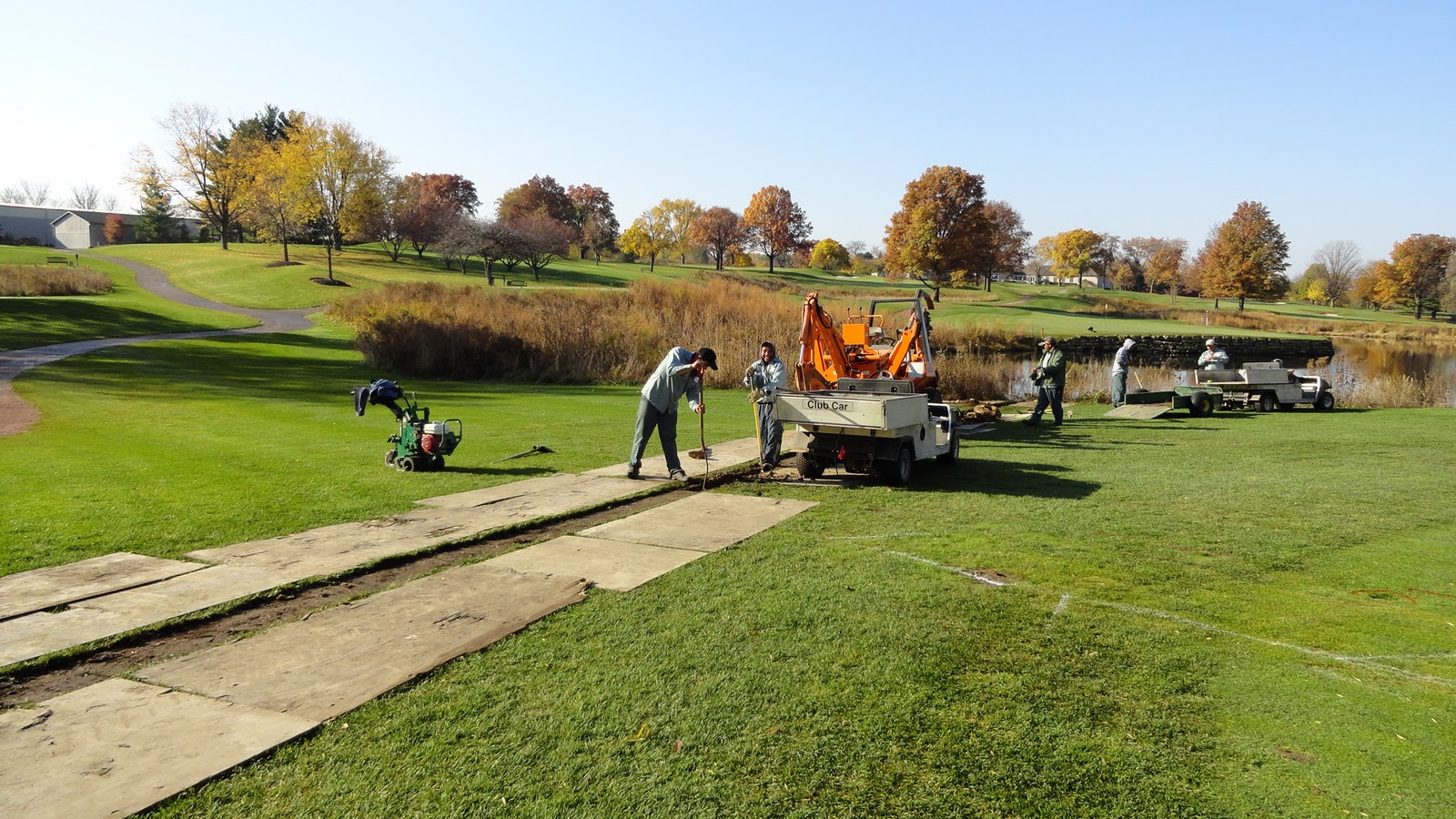
Yesterday we began trenching lines for a drain in 14 fairway.  This spot is one of the usual suspects when it comes to wet areas after rains.  This valley collects most of the water from the first half of the fairway.

The lines have been trenched and cleaned, and are now ready for gravel and pipe.  We hope to have this done by the end of the day tomorrow, and have it cleaned up for weekend play.  If you are out today or tomorrow, please be mindful of the workers in the fairway.
We have started to over seed areas in the fairways that thinned due to the hot and wet summer weather.  We hope to be finished with the fairways areas today, then start on the areas in the rough that were damaged by summer patch.

The first step is using an aerator with solid tines to poke shallow holes into the soil to create more soil surface area for the seed to contact.

We are then running our seeder over the area.  This seeded cuts shallow channels into the soil, then drops the seed into those channels.  It will likely be 2 weeks before we will see noticeable seed coming into these areas.

The fairways were also fertilized yesterday to aid with the recovery process as well.
This is a quick post to supplement the Divot Repair post from a month ago.  Erwin McKone is the Director of Golf Operations at Briar Ridge Country Club in Schereville, IN and has a YouTube channel, and World of Turf blog that I follow.  He has posted a good video regarding filling divots that I wanted to share.


Note: We do not have the divot bottles on our carts, and request that divots in the fairways be replaced when possible.  The Green Department will take care of any further repair.
Allowing air below the soil to exchange with air above the soil is a regular maintenance practice for us throughout the year.  We have many different pieces of equipment that we can use depending on what our ultimate goal is.  Through the summer we try to get through the course every 3-4 weeks, but use equipment that will cause minimal disruption.  We decided this week would be a good time after the very hot temperatures and the excessive amount of rain we received over the weekend.

On the greens and tees we used a "needle tine" on our aerators to create a small hole about 6 inches deep.

Conny spiking our tees today.

Here Torres is using our aerator to spike 4 green on Monday.

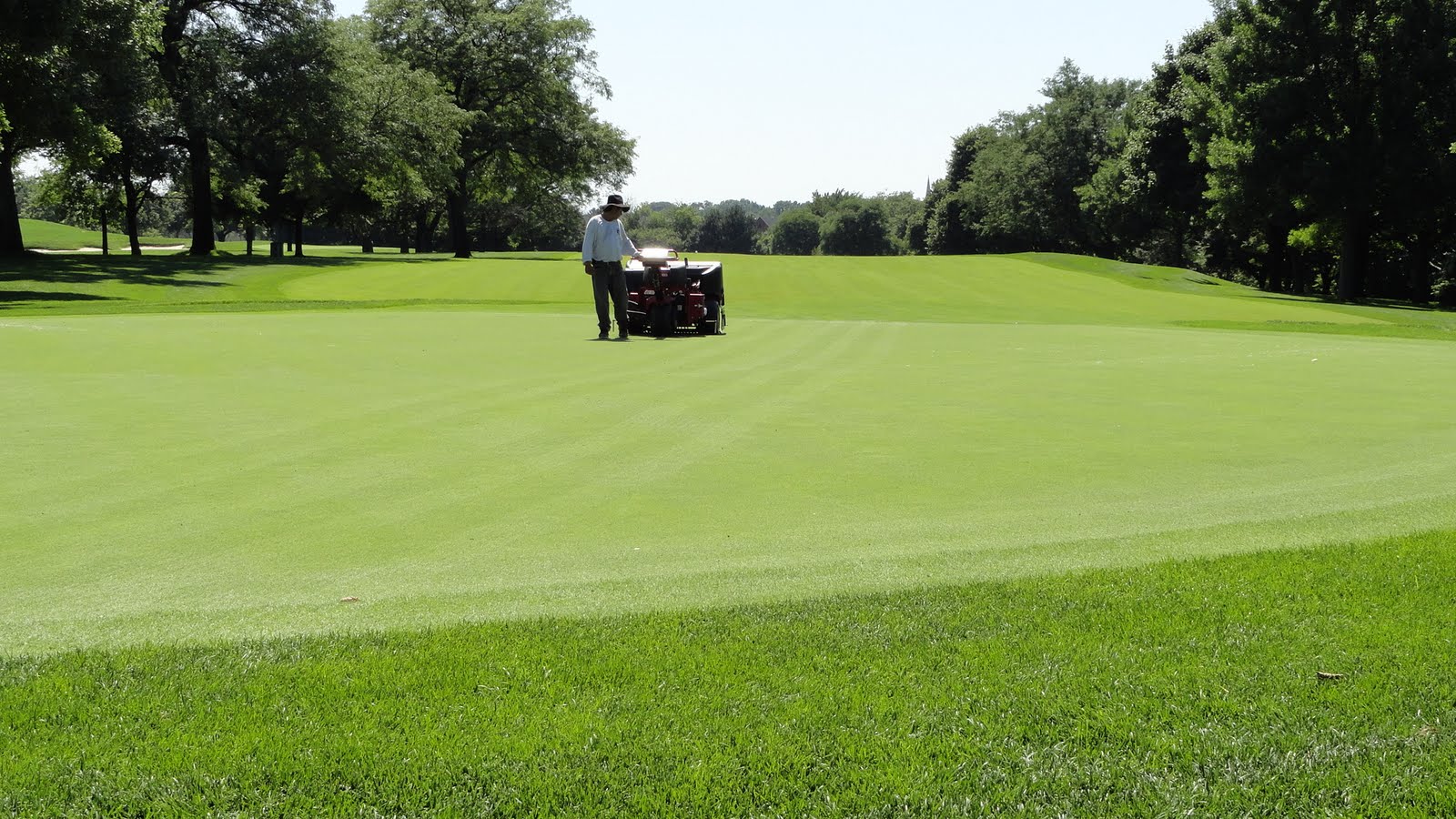
Torres is using a different piece of equipment to spike our fairways today.  It take one person about 10 hours to get through all of our fairways and approaches with this.

This is a nice piece of equipment to use in the summer.  It is quick, and leaves very discrete holes that are 2 inches deep.

The greens are done and the tees, fairways and approaches will be done by the end of today.  We hope that this will allow the soil to dry quicker and more evenly after being saturated for a few days, but more rain in the forecast over the next few days.  If it does rain, these holes will allow the rain the infiltrate the soil quicker.
This will be the first of a series of posts through the summer that will highlight the tools we use to monitor course conditions on a daily basis.  The first tool we will highlight is a Soil Profile Sampler.  We use this on a daily basis to see what is happening to the part of the turfgrass system that we cannot see from above ground.

Just like a hollow tine will pull a core when aerating, this tool pulls a profile of the soil that is about 4"x10".

From this profile we can monitor soil properties, rooting depth, moisture and organic matter accumulation.

This profile is from the fairway.  You can easily see the progress of our fairway topdressing program in this profile.

The profile fits easily back into the soil to prevent any lasting disruption to the surface.
Previous PostOlder Posts Home