Showing posts with label mowing. Show all posts
We have been fielding many comments over the last couple of weeks about the difficulty of the rough on the course.  This is not unusual for this time of year.  We have made posts to the blog previously about the growth habit of grass in the spring.  Here is a link to a post on May 16th (almost the same day) in 2011-It's Rough Out There!  There is nothing new to add to that post.

Spring is a usual time for rapid growth of cool season grass-like we have in the rough.  It is difficult to keep up with the rough mowing during all of the activities we like to accomplish in the spring.  We have been mowing the rough two times per week and localized spots have been getting mowed three times.  This rapid growth of the grass will pass and the course will play to what golfers are accustomed to playing in the summer and fall.

We do present 2 different heights of cut in the rough.  Our first cut of rough is 1 inch shorter than our second cut.  The first cut is 4 passes with our Sidewinder mower which will create approximately 20 feet of shorter grass around each fairway and 10 feet around the par 3 approaches.  This picture shows a ball sitting in the first cut of rough.

The second cut of rough is the lowest priority area on the course.  It is the area that we do the least amount of maintenance to.  This picture shows a ball sitting in the second cut of rough.

I am pasting here the last paragraph of the post "It's Rough Out There"  It is a great summary to the varying conditions on the course:

The course is ever changing.  In the spring the rough makes the course challenging, following a rain event you might not get 30 yards of roll in the fairways thereby changing your approach shot into a green, on a windy day your drive could be blown off course…  The influences that nature has on the course is integral to the game, it creates interest.  It is up to the player to adapt their game so as to overcome seasonal influences.
Slowly, things are coming along on the course.  We have done a first mowing on the fairway and approaches.  Greens were mowed again today for the second time.  The bunkers have been cleaned and one raking has been done.  It will take a few rounds raking the bunkers to get the sand in shape.  Rakes are in the bunkers now, so be sure to rake your tracks for the golfers behind you.  Tee markers are out on the course now as well.

We do not have a start date yet for the carts or the driving range tee.  We are waiting for the grass to start growing so it may recover from traffic and divots before we start to injure it.  We will plan on having the halfway house open next weekend.  Most of the crew was back this week.  A few more will start next week.  The weather forecast does not look too promising next week either. If mother nature ever decides to cooperate we will be ready to go!
Hopefully, we are through the summer heat at this point.  The recent cooler temperatures have been much more comfortable to work in and grow grass in.  We do several things through the summer heat to avoid damaging the grass more that necessary.  One is the use of carpets on our approaches near the greens.

This is an area of concentrated traffic where mowers constantly turn.  The greens mowers turn in this area, as well as the approach mowers.  The damage from the mowers rubbing on the grass while turning can be noticeable in stressful periods.

We will continue to use these carpets through the fall until our mowing frequency decreases.
Each year, right on cue, we field questions about thick and difficult rough conditions.  In a 2010 article titled “Spring Rough Is Rough”, Senior USGA agronomist Darin Bevard noted that difficulty of the rough was a topic of discussion at nearly all of his Turf Advisory Service visits. 

Fundementals of Turfgrass Management,  Nick Christians
Aggressive spring growth of cool season turf is normal.  As depicted in the graphic below, cool season grasses experience a primary surge of growth in the spring followed by a smaller (recovery) growth spurt in the fall.  Most superintendents maintain a rough mowing height of 2-3 inches, with the most common height being 2.5 inches.  As suggested by most golfers, the solution for challenging rough conditions is to lower the height of cut or and /or mow more frequently, sometimes this is easier said than done.  The frequency of rough mowing is usually dictated by available manpower and equipment.  Throughout the spring growth period we mow the rough Monday – Saturday.  Even with this effort it might not be enough to keep up with the growth rate of the grass.  If the rough is mowed at 2.5 inches on Monday it may be 3.5 -4 inches by Wednesday.  Height of cut is not the issue, frequency is the issue.  So why not just mow more often?

Spring is a very busy time for the maintenance crew.  As we prepare the course for the upcoming season we work our way through a long check list of items.  The list has over 60 items on it and represents thousands of man hours above and beyond normal course maintenance.  It takes the crew about a month to complete all the items on the spring job list.  Use of labor on items such as cleaning and edging bunkers, charging the irrigation system, building cart paths, spraying broadleaf weeds… tasks our ability to keep up with mowing the rough.  Mowing the rough one time (inclusive of green and tee banks) requires approximately 66 man hours and 11 different pieces of equipment.  While we are equipped and staffed well enough to mow the entire course in a single day, when we do so it requires the majority of our crew leaving no time for jobs on the spring checklist.  Throw in a couple of rain days and the issue of timing becomes even more complicated.  Since the rough mowing equipment represents some of our larger mowing units, wet course conditions can throw a wrench in our schedule for days.  Once work on the checklist is complete, then it becomes much easier to allocate resource to the rough.  Keep in mind that the rough is not considered to be one of the primary playing surfaces.  The concept of sustainable golf, as advocated by the USGA, focuses on “down the middle”, with primary consideration given to playing conditions of greens, tees and fairways.

This year we will be taking a different approach to rough mowing.  We will continue to mow a walkway (or dew path) extending from the tee box to the fairway.  This will be mowed 2-3 times a week at a height of 1 inch, but we will not mow the traditional 1 pass intermediate cut around the fairways.  Instead, we will mow a primary rough which will consist of 4 passes on each side of the fairway.  The primary rough will also include the descent (the area extending from the tee box up to the fairway).  The primary rough will be mowed 2-3 times a week at a height of 1.25 inches.  The remainder of the rough (the secondary rough) will be mowed once a week at our current mowing height of 2.25 inches.  The frequency of cut on the secondary rough will be increased during the spring time to keep up with growth, when growth slows then we will scale back to our once a week schedule.  We are also going to change the timing on a couple of our fertilizer applications to better manage spring growth. 


The course is ever changing.  In the spring the rough makes the course challenging, following a rain event you might not get 30 yards of roll in the fairways thereby changing your approach shot into a green, on a windy day your drive could be blown off course, in the fall the leaves make the course challenging…  The influences that nature has on the course is integral to the game, it creates interest.  It is up to the player to adapt their game so as to overcome seasonal influences.
The greens have been very slow this week.  We are working to fix this as soon as we can, but it will likely take a few days to fix this issue.  Our mechanic, Greg, has been away from the course on an unexpected temporary medical leave since Friday, May 6th.  Thankfully, Greg has been able to return home, and is expected to be back to work next week.  As you have noticed this week, Greg is extremely important to our quality of cut and it's impact on green speed and smoothness.  We have done our best to continuously adjust the mowers, but we are off our sharpening schedule.

The warm weather this week has been excellent for golf, but is also working against us in this area.  The warm nights allows the grass to grow more through the night which results in more leaf tissue on the surface.  When the mowers are not as sharp as they should be, that means more leaves are being left behind resulting in slower greens.
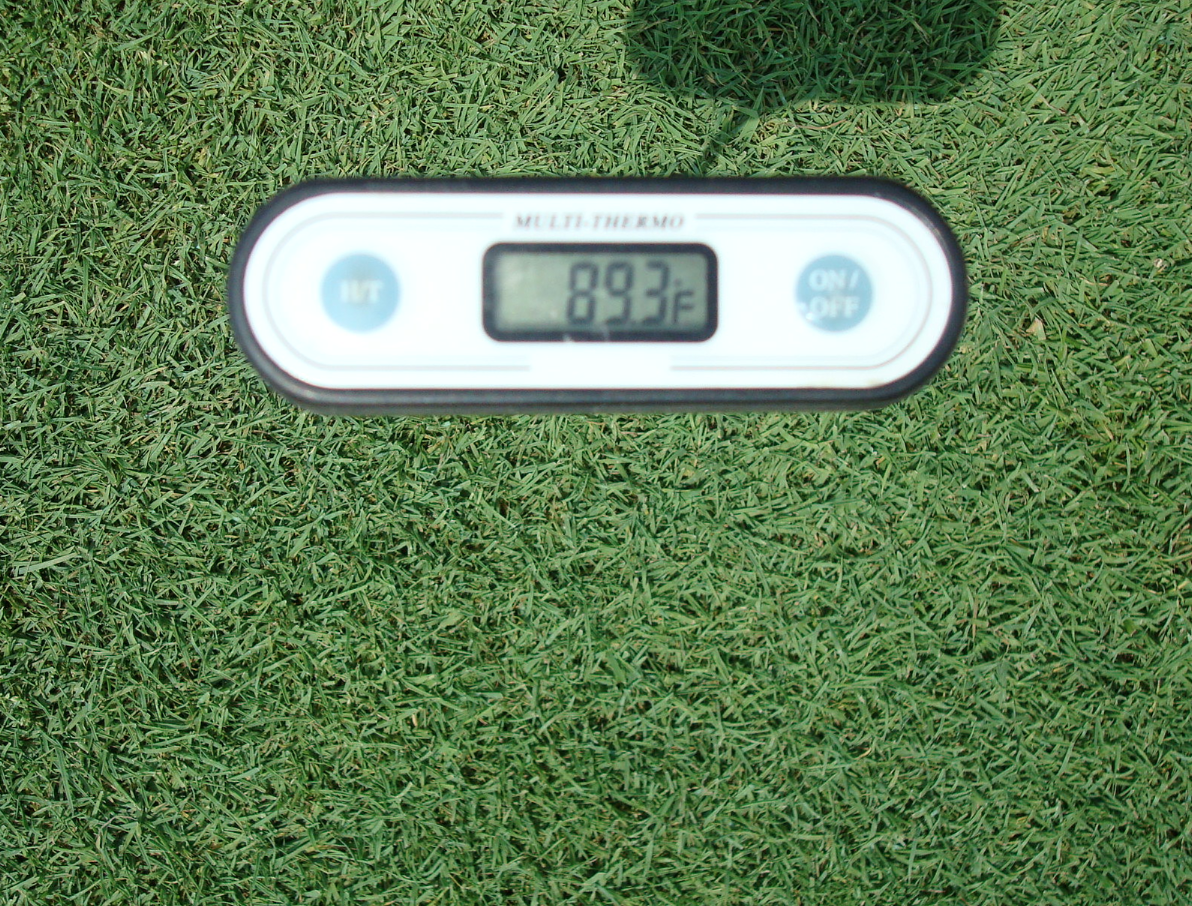
This was the soil temperature reading on 12 green yesterday morning.  Our weather station logged a low of 31.1 degrees last night which gave us a frost delay today and will bring the soil temperatures down a little more.  This will not injure the turf, but it will make for a slow start to the year.  Though the grass is green, at these temperatures, the grass is not growing.  Last year during the middle of April our soil temperatures were between 60 and 65 degrees which is a more ideal growing condition.

These cooler temperatures have given us the opportunity to get more little projects done rather than concentrating on mowing everyday.  We have been able to weed and prep our pine beds, chip a pile of limbs into mulch, clean the fence rows along the property lines and get our beginning of the season bunker work done.

This was the soil temperature reading on 15 green yesterday.  It forecast does not show a dramatic warm up, so it looks like this slow start will last another week.
Each winter we spend time evaluating the prior year so that we can better prepare ourselves for the challenges that lie ahead.  By all accounts the summer of 2010 was a difficult year.  Courses throughout Chicago and across the eastern United States lost turf as the deadly combination of high heat and excessive rain caused cool season turf to collapse.  To understand the origin of the problem you actually have to go back to the winter of 2009-2010.  The summer of 2010 was preceded by the 5th longest winter on record in the Chicago area.  By March of 2010 we had already experienced 97 days where the daytime high temperature failed to reach 50 degrees.  Plant photosynthesis is very temperature dependant; it is greatly diminished at both high and low temperatures.  A long winter means the plant has a very shallow root system and that reserves are extremely depleted.  During the spring period the plant works to recover from winter damage, store carbohydrates, and develop the root system that it will need to carry it through the summer stress period.

When summer did arrive it arrived with a bang.  In 2009 the Chicago area posted only 6 days where the high temperature broke the 90 degree mark.  In 2010 that number was quadrupled with 26 days breaking the 90 degree mark.  This is consistent with Chicago’s trend of really hot summers occurring about once every 12 – 14 years.  The summers of 1983, 1995 and 2010 are etched in the minds of local superintendents as difficult years to keep turf alive.  To compound things, in 2010 the heat was combined with excessive rain that caused flooding and water logged soils.  Hot, humid, and wet is a deadly combination for cool season turf grasses.  Root zone oxygen is displaced as soil pore space fills with water.  Water logged soils retain heat at a rate 10 times greater than that of oxygenated soils.  Saturated soils that heat up during the day retain heat overnight, never cooling down.  When air temperatures climb above 85 degrees the plants ability to undergo photosynthesis begins to diminish.  As a result the plant rapidly uses up all of its stored carbohydrate reserves, (reserves that were deficient to start with due to the prolonged winter) and is left to starve to death as its shallow root system boils in a primordial stew.

In this weakened condition the plant is easy prey for opportunistic fungal diseases.  While fungi are always present, they are normally held in check by environmental conditions and the plants natural ability to fend them off.  Physiological decline of the grass plant leaves it vulnerable to a myriad of plant pathogens including: brown patch, waitea patch, summer patch, take-all patch, localized dry spot, fairy ring, dollar spot, anthracnose and pythium blight.  The relationship between the plant, the environment, and the fungi is typically referred to as the “Disease Triangle”.  In 2010 there is no doubt that the “Disease Triangle” was out of balance and the fungi had the upper hand.  Dr. Derek Settle is the plant pathologist employed by the CDGA; he is stationed at the Midwest Golf House.  As part of his service Derek makes site visits to local Chicago courses to help diagnose turfgrass related problems.  In 2009 Derek did site visits at 50 local courses.  In 2010 Derek received calls for site visits from 136 courses (we had Derek out a couple of times last year); this is the most calls that Derek has received dating back to 2006 when he was hired by the CDGA.

Granted, not all courses experienced turf loss, so this begs the question – why?  Typically the answer has to do with course micro climates.  You need not compare one course to another to find microclimates; you can identify microclimates within NCC.  The left edge of #5 fairway was hard hit by an outbreak of pythium, yet the 18th fairway was undamaged – why?  The truth is that there is a micro climate that exists on the left side of #5 fairway.  It is a low area that sits wet longer following rain events.  The dew burns off slower on the left side of #5 contributing to leaf wetness and disease pressure.  In the winter time the tree line along the fence on #5 shades the left half of the fairway causing prolonged snow and ice cover, this means the turf on that side of the fairway is weaker coming out of winter.  The combination of the tree line on the left and the hillside on the right reduce air flow over the fairway.  Stagnant humid air reduces the ability of the grass plant to undergo evapotranspiration (ET).  This is the plants cooling mechanism; it is very similar to how we cool ourselves through the process of perspiration.  Think about what happens if you sit in a hot humid steam room for too long.  Once you have had all you can take you leave the sauna and find relief in the cool air outside the sauna.  The turf does not have the ability “leave the sauna” and seek out the air conditioning and a cool beverage.  It has to survive long enough for relief to come in the form of a drop in night time temperatures.  As the air and soil temperatures cool down the plant finds relief.  If the temperature doesn’t drop, or is the soils are saturated with water and are retaining heat, then the relief does not come.  A surprise thunderstorm on a 90 degree summer night can be a superintendent’s worst nightmare.

So how do we build on this for 2011.  Sound agronomic practices are the key to surviving periods of stress.  Aerification, thatch management, proper fertility, proper irrigation, good drainage, proper air exchange within the root zone, good air movement over the turf, proper exposure to sun, good mowing techniques, proper stress management, adequate topdressing, the use of proper grass varieties, and plant protectant programs are all part of developing a successful turfgrass management program.  Each winter we evaluate and refine our program.


Related posts from last year:


This week we tried to take advantage of the cooler temperatures to do some verticutting.  We preferred to accomplish this during the cooler temperatures because to the level of aggressiveness we wanted to take with the practice.  We used a new piece of equipment that will remove more material from the turf surface.  Our goals for the approaches was to stand up some of the grass that has been laid over from mowing the same stripe continuously in an effort to achieve the look we want.  This verticutting will be a usual practice with this mowing pattern.  Due to the level of aggressiveness we took, the approaches may look a little yellow or brown for a week to two weeks while the turf begins to fill in some of the areas where leaves were removed.  Even though the short-term results in some off color turf, the long-term benefits are well worth the effort.
Today and yesterday's labor was directed towards completing a final mowing on all areas of the golf course. Temperatures have become cool enough and days short enough to cause the grass to slow it's growth for the winter months.


Alejandro mowing the 11th green on Thursday.


Torres mowing the 5th fairway on Thursday.


Greens, fairways, and approaches were mowed for the final time on Thursday. Tees and rough were mowed for the final time Today. There only remains a small number of leaves in the trees, so the final rough mowing today will mulch the leaves on the ground as well. Now that the last of the mowing is done, we will begin a thorough cleaning of all the mowing equipment next week.

When in the course of a renovation of the scale the club performed a few years ago, it is often necessary to utilize the most efficient measures possible to complete the maximum amount work. As work on the course progressed, the west side of the course was seeded first as earth work continued on the east half. As the grass germinates and grows it becomes necessary to begin a regular mowing schedule. However, the construction work on the other half of the course is still continuing. It then becomes necessary to manipulate the mowing schedule to accommodate the ongoing construction work.

During construction, it was decided to mow the bunker faces at 4" which would allow for a longer interval between mowing. This would enable the labor to be directed to other parts of the renovation that were still ongoing. Through one of the many course inspections during the renovation, one of these bunkers and it's 4" hair cut were happened upon, and it was decided to continue this maintenance throughout the course. Though this accident may never share the stage with the microwave or champagne, it works out well for the club and is still in place today.

The fairway cut leading into the bunker on the fronting edge was part of the plan from the beginning. This was desired to allow the bunkers to be more in play for shots that run toward them. A line of rough would prevent the golf ball from rolling into the bunker.

Both of these feature do require some unique maintenance requirements. The long grass on the face of the bunker is still mowed at 4", and is cut on every other Monday. So, on Sundays before our scheduled mowing, the grass could be rather long. Allowing this grass to be mowed every other week, rather than weekly, or twice weekly, significantly reduces our labor costs. The fairway height cut on the edge of the bunker is usually mowed twice a week with a walk mower. This job also mows several passes around the edge of the bunker which allows the fairway mowers more room to turn.

All of this adds up to the unique look the bunkers possess.
Our ultimate task on Fridays is to complete all of the mowing of the primary playing areas. Thursdays are used for mowing our rough, and trimming around trees. The areas we try to mow every Friday before the weekend play are greens, tees, fairways, approaches, green collars, green, tee, and fairway intermediate rough cut, green banks, weedeat around trees and mow the entrance and the clubhouse.

Our beautiful Friday morning.

Green Mowing - The greens are mowed everyday except on Mondays when the course is closed. This job takes 4-5 people to complete. The greens mowers are also responsible for raking the green-side bunkers.

Juan and Samuel mowing the 7th green.

Marcial and Antonio raking a bunker on 6.

Tee Mowing - Tees are usually mowed 2 times during the week. 3 people are necessary for this job. The tee mowers also mow the targets on the driving range.

Armando mowing the forward tee on 15.

Approach Mowing - Approaches are mowed 2 time per week, usually on Tuesday and Friday. This job takes 3 people to complete. Approaches are mowed from the green out to the first sprinkler head in the fairway. The par 3 approaches are mowed with this job, as well as all the collection areas around the greens.

Conny mowing the approach on 15.

Fairway Mowing - Fairways are mowed 2 times per week. We have 3 people complete this job. The driving range fairway, the driving range tee, and the chipping green approaches are all mowed with the fairways.

Ramon mowing a fairway.

Rough - All of our rough is mowed 2 times per week. There are various jobs, completed on various days, to accomplish the rough mowing. Most days during the week involve some type of mowing in the rough. We use a gang mower pulled by a tractor to mow the bulk of the rough. Riding mowers are used to mow around trees and any areas the tractor is unable to navigate. We use a different set of riding mowers to mow the areas from the tee to the fairway, and immediately around the fairway. We walk mow our green and tee banks with walk-behind mowers. The intermediate cut around the fairways, greens and tees is also mowed at various day through the week.

Ramon mowing the rough on our green banks.

Push mowing the intermediate rough cut around our tees.
Previous PostOlder Posts Home